What to do when the AC goes out in Oklahoma

RepairCentral ACOklahoma
Step 1 of 2

What ZIP code is the job in?

What do I do if my AC stops working in Oklahoma?

When your AC quits in July or August here, the house heats up fast and the humidity makes it worse. You want to know what to check before calling someone, and what actually needs a licensed hand versus what's a quick fix you can rule out yourself in the next few minutes.

Check the thermostat and breaker first, then get a repair tech out

Start with the thermostat. Make sure it's set to cool and the temperature is below the room reading. Next check the breaker panel. Oklahoma summers push air conditioners hard, and a tripped breaker from the compressor drawing extra current on a hot day is common. If the breaker's fine and the thermostat looks right but the system still won't run, or it runs and blows warm air, that points to something inside the unit: a bad capacitor, a refrigerant leak, a failed contactor. Those need someone licensed to open the system and diagnose it correctly. Running a unit that's low on refrigerant or tripping a breaker repeatedly can damage the compressor, and a compressor replacement costs far more than the repair that would have caught it early.

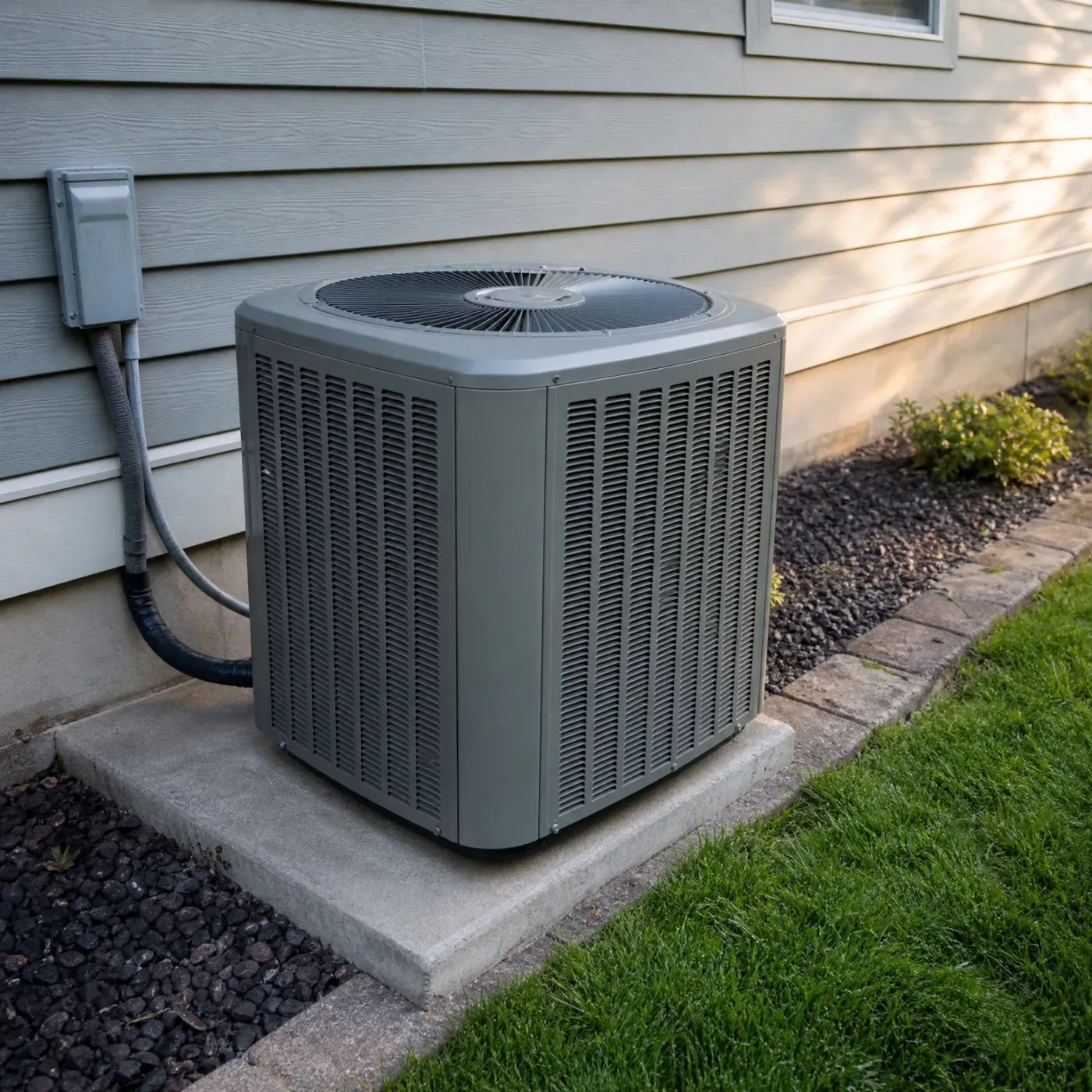
An outdoor air conditioner condenser unit beside a light-colored lap-sided house with an electrical disconnect box on the wall, surrounded by shrubs and lawn in low evening light.

You're out back around seven, grass still warm underfoot, and the air conditioner by the fence has gone quiet in a way that isn't right. No hum from the fan. You walk over and the blades inside the cage sit still while the rest of the unit ticks like it's trying. Inside, the house is already a few degrees warmer than it was an hour ago, and with the sun just dropping behind the roofline the heat in the air hasn't let up at all. You crouch down near the condenser, listening for a click that doesn't come, and somewhere behind you through the kitchen window you can hear the dog already panting.

Call a Pro or Check It Yourself

Call Now

  • If the air feels warm and the thermostat shows no change after ten minutes, the system isn't actually cooling, not just catching up.
  • Breaker that keeps tripping means something is drawing too much power, and resetting it again can damage the compressor.
  • Ice on the lines or the indoor coil points to low refrigerant or restricted airflow, and running it longer makes that worse.
  • A burning smell or a breaker box that's warm to the touch is an electrical problem, not something to wait out overnight.
  • Water pooling near the indoor unit usually means a clogged drain line or a cracked pan, and it won't clear itself.
  • A compressor that hums but won't start is drawing current with nowhere for it to go, and that wears the motor fast.

Check Yourself First

  • Look at the thermostat battery and the setting before anything else. A dead battery or a setting bumped to heat looks like a bigger problem than it is.
  • Check the breaker panel for a tripped switch. If it resets and holds, the system may just need a minute to restart on its own.
  • Walk outside and look at the condenser fan. If it's covered in grass clippings or leaves, clearing the area around it can restore airflow.
  • Check the air filter. One clogged with dust restricts airflow enough to make the whole system struggle, even though it's running.
  • Look at the outdoor disconnect box next to the unit. Sometimes it gets bumped or left open after yard work or a storm.
  • If the indoor coil has a light layer of dust but no ice, a simple filter change might be all that's needed before it runs normally again.
A two-story house with gray and light gray siding, white-trimmed windows and a white front door, flanked by deciduous trees, with a partly browned lawn in front under a clear blue sky.

Summer air here holds a dew point around 66°F, according to NOAA climate data for Oklahoma. That's the number that makes the heat feel heavy instead of just hot. Your air conditioner isn't only lowering the temperature, it's pulling that moisture out of the air, and the wetter the air, the harder the system works to do it. When something fails, cooling stops but the moisture doesn't, and the house turns muggy within the hour, not just warm. That's why a unit that goes down here needs attention sooner rather than later. Once you send the request, you're not the one making calls or waiting on hold trying to find someone free. A local contractor who works on this equipment all summer takes it from there.

NASA POWER T2MDEW county cells weighted by homes

Stop chasing an air conditioner pro

Only one pro gets your request, so you hear from one company.

Asking costs nothing, and the choice to hire stays yours.

Why the outdoor unit matters most

The outdoor unit is doing the harder job. It has to dump heat from inside your house into outside air that might already be near 100°F, and a dew point around 66°F means that air is carrying a lot of moisture too. That compressor runs longer and works harder here than it would somewhere dry and cooler. When it short cycles, trips a breaker, or hums without starting, the strain usually comes from a failing capacitor, a dirty condenser coil choked with cottonwood or grass clippings, or a run of low refrigerant that makes the compressor fight to do a job it can't finish.

What a local contractor already knows

A contractor who works on Oklahoma systems every summer has likely seen the same unit, the same wiring, and the same failure a dozen times this season alone. They know a capacitor that's been swelling for weeks finally gives out on the hottest afternoon, and that a coil packed with debris from a dry spell can mimic a refrigerant leak. That's the kind of read that comes from doing this work locally, not from a manual. One licensed contractor gets the call, looks at your actual unit, and tells you what's wrong instead of guessing from a list of possibilities.

A gray-haired man in a dark sweater sits on a light gray sofa in a living room, looking toward a sunlit window with trees outside.
A gray-haired man in a dark blue sweater sits on a light gray sofa in a sunlit living room, looking off to the side, with a potted plant, shelving unit, and large glass doors behind him.
A bearded man with graying hair in a dark green sweater sits on a sofa in a living room, looking off to the side, with a sliding glass door and a dim kitchen doorway behind him.
A gray-haired man in a dark knit sweater sits on a light gray sofa in a living room, looking toward a sunlit window, with houseplants, a lamp, and framed art in the background.

Most calls trace back to a handful of parts, and they tend to fail in a chain. The capacitor gives the compressor and fan motor the jolt they need to start. When it weakens, you hear a hum but nothing turns. The contactor is what feeds power to the outdoor unit in the first place, and its contacts wear down after thousands of cycles, sometimes sticking closed, sometimes not closing at all. Refrigerant that's low doesn't always mean warm air right out of the gate. It often shows up first as ice forming on the copper line, with the system still running and still failing to cool the house. The fan motor can go out on its own too, leaving the compressor running with no air moving across the coil to carry heat away. Inside, a clogged condensate drain will trip a float switch that's built to shut the whole system down rather than let water back up into the house. None of these are guesses. They're the parts a contractor checks first, in roughly that order, because that's the order they tend to go.

What Actually Fails Outside

  • A contractor checks the capacitor first, because a weak one lets the compressor hum without starting the fan or the compressor itself.
  • The contactor is the switch that sends power to the outdoor unit, and its contacts pit and stick after enough cycles.
  • A low refrigerant charge shows up as ice on the copper line, not as warm air right away, which is why a system can run and still fail to cool.
  • The outdoor fan motor can seize or wear out on its own while the compressor keeps running, so the unit hums but blows no air across the coil.
  • A clogged condensate drain trips a safety switch built to shut the system off before water backs up into the house.
  • Dirty coils outside make the compressor work harder to dump heat into the air, and that strain is often what takes out the capacitor next.
A gray outdoor air conditioning condenser unit on a concrete pad beside a house with horizontal siding and a stone veneer base, with a wall-mounted disconnect box and conduit, next to a shrub bed and a concrete patio.
A unit like this is running a normal cycle: steady fan, clear airflow around the pad, nothing blocking the coil.
An outdoor air conditioner condenser unit on a concrete pad beside a house with light gray vinyl siding, with a gray electrical disconnect box and conduit on the wall, gravel beds and dried plants nearby, and a concrete sidewalk in the foreground.
An older unit crowded by gravel and weeds strains harder to shed heat, and a worn disconnect box is worth a look too.
  1. A contractor checks the thermostat signal reaching the outdoor unit first.

  2. Next comes a check of the breaker and the disconnect box for power.

  3. The capacitor gets tested, since a weak one stops the compressor cold.

  4. Refrigerant pressure gets checked last, once electrical causes are ruled out.

A middle-aged woman with shoulder-length dark hair, wearing a gray cardigan over a cream top, sits in an upholstered armchair and looks toward a sunlit window, with a shelf holding framed pictures and a plant behind her.
A woman and a child wrapped together in a knitted gray blanket on a couch, with the child's head resting on her shoulder and a lit table lamp and houseplant in the background.
A gray outdoor air conditioning condenser unit on a concrete pad beside a house with horizontal lap siding, with a conduit and electrical disconnect box on the wall and a green shrub in mulch to the right.

Running clean

This unit sits clear on its pad, nothing crowding the grille. The line set runs straight up to the disconnect, no corrosion visible, no debris near the base. A system kept clear like this sheds heat the way it's supposed to, and the compressor isn't working harder than it has to.

A weathered outdoor air conditioner condenser unit on a concrete pad beside a house with horizontal vinyl siding, with a conduit and disconnect box on the wall to the right.

Choked with debris

Leaves and dirt have packed into the grille here, and the housing shows years of weather on it. That buildup blocks airflow across the coil, so the unit runs longer to move the same heat. Left alone through another Oklahoma summer, it's the kind of strain that ends with a service call.

Power costs 13.21 cents per kilowatt-hour statewide

At 13.21 cents per kilowatt-hour, running your AC hard through July and August won't wreck the bill the way it might elsewhere. That's worth knowing when a contractor says a part needs replacing instead of nursing along. Paying for the fix is the smaller cost next to another week of Oklahoma heat indoors.

EIA-861 2025 statewide residential average

An outdoor air conditioner condenser unit on a concrete pad beside a house with horizontal lap siding, with a conduit running to a gray electrical disconnect box on the wall.
Before you get your air conditioner repair
A gray outdoor air conditioner condenser unit on a concrete pad beside a house with horizontal lap siding, with a wall-mounted disconnect box and conduit at left and a green shrub and mulch bed at right.
After you get your air conditioner repair
A gray outdoor air conditioning condenser unit on a concrete pad beside a house with horizontal lap siding, with a wall-mounted disconnect box and conduit, and shrubs to the left.

Working the way it should

The fan spins steady, the pad underneath is clear, and the disconnect box on the wall has no rust at the fittings. Conduit runs clean down to the unit. A system that looks like this is cycling on and off the way it's built to, cooling the house without strain.

An outdoor air conditioning condenser unit on a concrete pad beside a house with horizontal siding and a concrete foundation, with dry brown leaves on the ground to either side.

Struggling to keep up

Leaves piled against the cabinet, grime on the fins, a unit that looks older than it is. Refrigerant lines and conduit run along the wall same as the other one, but dirt and debris around the base make it work harder to shed heat, and that's often where trouble starts.

A quiet outdoor unit on a hot afternoon almost always comes down to the capacitor, the contactor, or the breaker, and a licensed contractor checks those in that order before touching anything else. You don't need to know which one it is. You need someone who's worked on units like yours all summer and already has a sense of what's likely before they open the panel. Once you send the request, it goes to one licensed contractor local to your area, not a handful of companies competing for the callback. That's one person who knows this equipment, not a stack of strangers. Your house will cool back down once the right part gets replaced, and most of what fails on these units is routine work for someone who does it every week in weather like this. The muggy air made the problem feel worse than it is. The fix itself is usually smaller than the heat made it seem.

A gray outdoor air conditioning condenser unit on a concrete pad beside a house with horizontal lap siding, with a wall-mounted disconnect box and conduit, lava rock mulch, a shrub, and grass nearby.

Hand off the air conditioner problem

Hand off the search

Your request stays with one local pro.

No fee to send it, and nothing to sign.