
5 months of cooling
May through September, condensation sits on the cooling coil almost every day. That stretch gives mold the steady moisture it needs to take hold in your ducts.
Get matched with a pro who works on ducts in Oklahoma County.
Find a pro near meA musty smell from your vents almost always means mold or mildew growing somewhere in the duct system, usually in the cooling coil or a section of duct that stays damp. In Oklahoma City, where summers stay muggy for months, the air conditioner pulls a lot of moisture out of the air, and that moisture has to drain away. When the drain line clogs or the coil doesn't dry out between cycles, water sits there and grows mold, and every time the blower runs it pushes that smell through the house. A dirty filter makes it worse by slowing airflow across the coil, so it stays wet longer. Sometimes the smell comes from standing water in the drain pan instead, or from a duct that was never sealed right and lets in damp crawlspace air. Either way, the smell is a sign of moisture somewhere it shouldn't be, not something that clears up on its own. It usually calls for someone to find where the water sits and clean it out.
Half the homes here were built by 1978
Ducts run nearly five months of cooling a year, May through September, so condensation has months to sit on the coil and breed mold.
Heat runs October through April
Heat runs October through April, about seven months, which dries the ducts out but also means long stretches with no airflow to check on.
Cooling runs May through September
Half the homes in Oklahoma County were built in 1978 or earlier, and older duct runs are more likely to have gaps or insulation that holds moisture.
ACS 2020-2024 · NOAA nClimDiv 1991-2020
If the smell only shows up when the air conditioner first kicks on, that points to the cooling coil. Moisture sits on the coil between cycles and mold grows in that damp, dark space, so the first blast of air carries the smell before it fades. This is common in Oklahoma City because the system runs for months at a stretch through the muggy summer, and the coil rarely gets fully dry until fall. A cleaning that reaches the coil and the drain pan usually clears a smell with this pattern. If it fades within a few minutes of the system running, the coil is the likely source.
A smell that is there whether the system is running or not points somewhere else in the ductwork, not the coil. Mold growing inside the duct lining or in a section that holds moisture from a slow leak or poor sealing will keep putting off a smell around the clock. This can also mean the growth has spread beyond the coil into the supply or return runs. A full duct cleaning, not just a coil service, is what addresses this. If the smell is just as strong first thing in the morning as it is in the afternoon, the ducts themselves need attention, not only the coil.




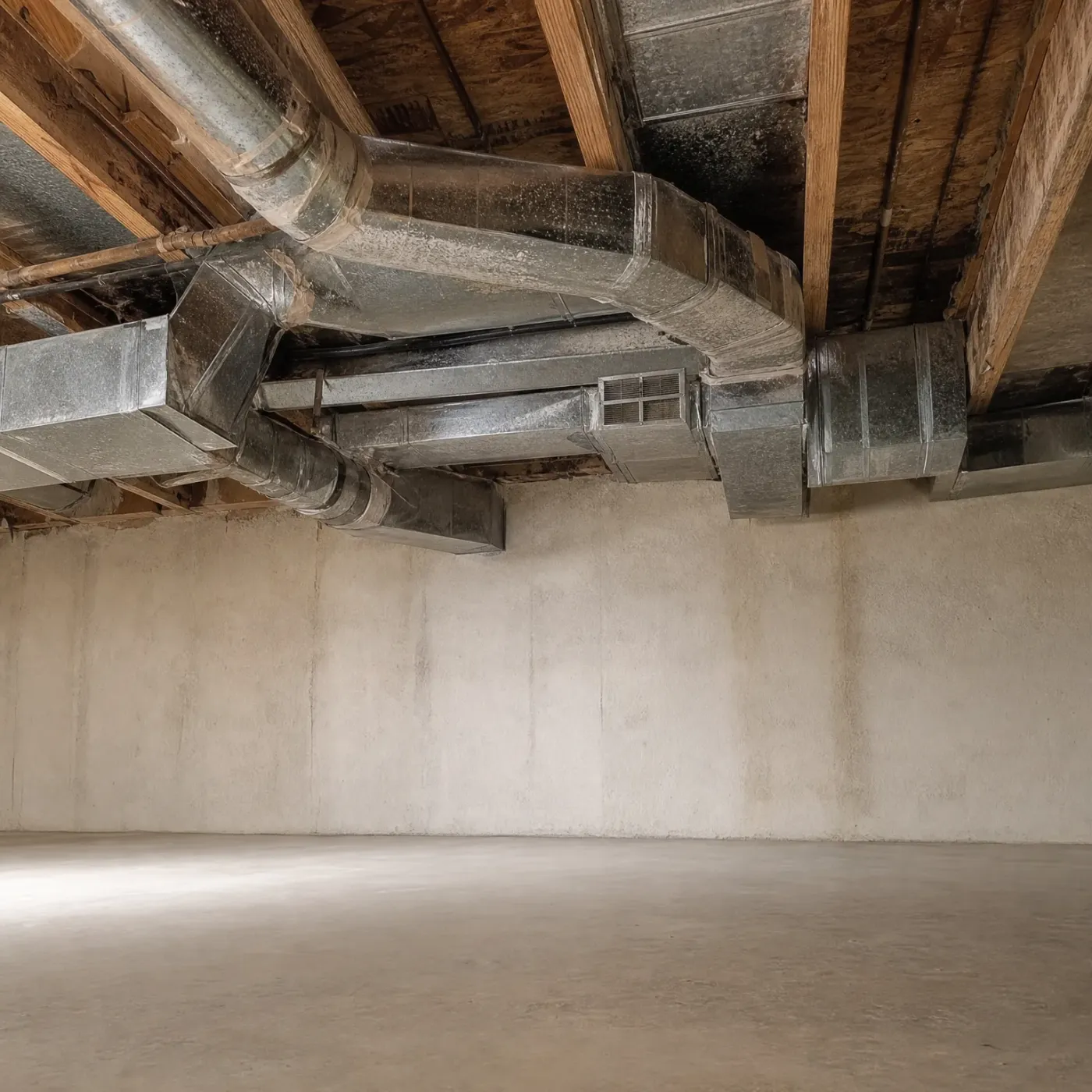
A duct system does not need much to grow mold. It needs water sitting somewhere, dust for the mold to feed on, and air that is not moving, and a system that runs all summer without attention gives it all three. The cooling coil is the usual starting point. After the compressor shuts off, the coil stays wet for hours, and that standing water on the metal fins is where colonies take hold first. From there it spreads easier in flex duct or duct board than it would in bare sheet metal, because the inner surface on those materials is porous and holds moisture and odor longer. A clogged condensate line makes it worse. Once that line backs up, water collects in the drain pan and can turn musty in a matter of days. Dust buildup inside the ducts adds fuel to all of it, turning a damp coil into a bigger problem faster than a clean one would. Clearing it out means cleaning the coil, the drain pan and the duct interior, and checking that the drain line runs clear so water has nowhere left to sit.


May through September, condensation sits on the cooling coil almost every day. That stretch gives mold the steady moisture it needs to take hold in your ducts.
Send the form and a contractor who handles duct cleaning in Oklahoma City reaches out to you. Sorting out the smell stops being something you have to chase down alone.
You probably catch it most when the air first kicks on, a damp, closed-up smell like a basement, then it fades. Walk up to a vent and it is stronger there. You might notice it more in rooms the air barely reaches, or see a faint dark ring around the vent cover itself. Some households notice it hits harder right as summer starts, after the system has sat idle. None of this is in your head. If it sits long enough, mold spores are moving through the air you breathe in every room the ducts reach, and anyone in the house with allergies or asthma usually feels it before anyone else does.
Moisture collects on the cooling coil and nearby duct sections
Dust settled in the ducts gives mold a food source
Mold and mildew colonies grow across the damp duct surfaces
Air moving through the ducts picks up the musty smell



Send the form and the duct cleaning stops sitting on your list.
Get matched with someone who does this kind of work in Oklahoma County.
No fee to send it, and nothing to sign.
At 12.35 cents a kilowatt-hour, running the blower longer than it needs to run costs you less here than it would elsewhere. That's little comfort if mold is building up in the ducts, since a dirty system still has to push air past that buildup every time it cycles on.
EIA-861 2025

It is a Saturday afternoon in April and the windows have been open for a week, but the air conditioner just kicked on for the first time this spring. You are folding laundry on the couch when you notice it, that closed-up, damp smell, like a basement. You look up. The ceiling vent above the armchair has a gray ring of dust around the grille, and when you run a finger along the louvers it comes away gritty. A thin film of dust sits on the side table under the vent too, the kind that was not there last week. The air coming out feels fine, cool enough, but the smell sits in the room for a few minutes before it fades.
It seems like it should be a weekend job. Pull the vent covers off, wipe them down, run a vacuum attachment up into the duct as far as it reaches, maybe spray something that smells like pine. The covers come out clean enough, and that feels like progress, so it is worth asking whether that is actually solving anything or just moving the smell around for a week.
A vacuum hose reaches a foot or two into the duct at most. The mold causing the smell is usually on the cooling coil or deeper in the duct run, well past where a household vacuum or a brush on a stick can get. Wiping the covers and the first few inches of metal can cut the smell for a few days, then it comes back, because the colony that is actually producing it was never touched. A proper duct cleaning uses equipment that reaches the full run and the coil itself, with brushes and negative pressure that pull the growth out rather than push it further in. Until that happens, the smell is likely to keep returning every time the air conditioner cycles on.

You can keep the house cool and just live with it. The air conditioner doesn't care that mold is growing in the duct system, it will run the same whether the coil is clean or coated. But every cycle pushes air across that buildup and into your rooms, so the smell doesn't fade on its own. It tends to get stronger as the summer goes on, not weaker, because the coil stays wet for months at a time.

A contractor who cleans the ducts removes the dust and growth from the coil and the duct runs where it collected. The air conditioner keeps running the same hours it always did, May through September, but the air coming out of the vents isn't picking anything up on the way. The smell doesn't come back just because the weather turns humid again. It comes back only if moisture and dust are given the same months to sit undisturbed that let it grow the first time.

The smell is mold or mildew somewhere in the duct system, most often on the cooling coil where condensation sits after every cooling cycle. That's true whether it hits you the second the air kicks on or only in the one bedroom the air barely reaches. The cause is the same either way, and so is the fix: the ducts need to be cleaned out, not sprayed over or ignored until fall.
You don't have to figure out which section of duct is holding the moisture or how far the mold has spread before you do anything about it. Send the form and a contractor who works on duct systems in Oklahoma City gets your information and reaches out. From there it's their job to find it and clean it out, not yours to track down.

The right pro for this job